
-
Traffic signs
manufacture since 1993 -
We are certificated company
ISO 9001, EN 12 899, EN 12 966
Linear traffic management for road closures
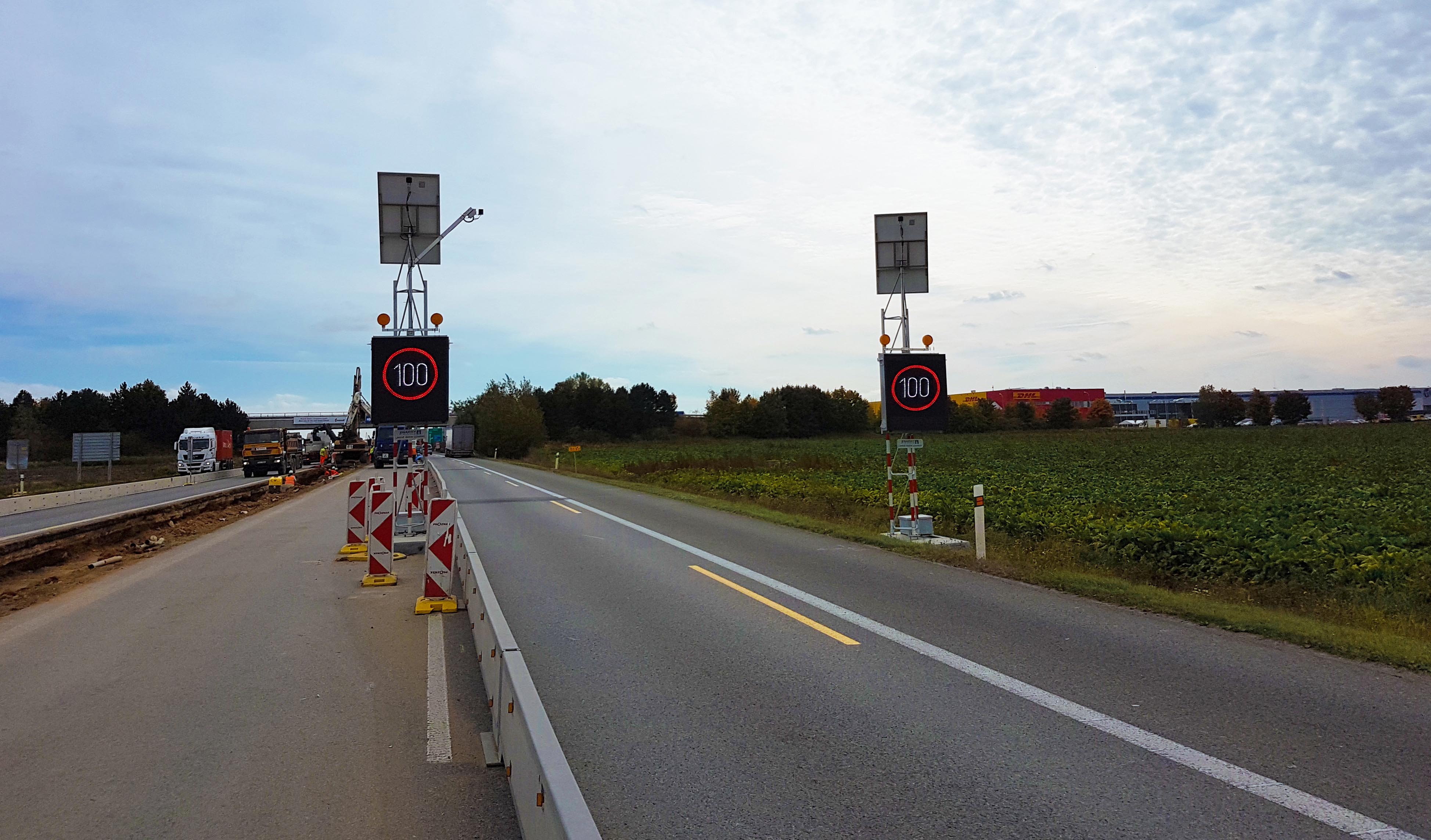
We have successfully implemented a completely new technological system for linear traffic flow management and queue warning in roadwork zones and at restrictions using variable message signs.
D1 project (km 210–215) using variable signs with rotating prisms
The system was first deployed during roadworks on the D1 motorway between km 210 and 215. Variable message signs, which experience shows are more readily accepted by drivers than permanent fixed signs, display information about the current traffic conditions before the road closure. According to specialist literature, deploying such a system can reduce losses caused by accidents in queues by up to 50%. Improving safety within the roadwork zone also reduces the number of queues caused by accidents.
The dynamic warning sign system designed for the D1 is based on similar systems used on German motorways. It consists of variable warning signs with rotating-prism technology, detectors recording vehicle speeds and traffic volumes in both lanes, cameras monitoring traffic at critical points, control units and data transmission equipment, an autonomous power supply using solar panels and backup sources, and control software. The software records traffic data and automatically sets the warning signs to predefined positions according to current traffic conditions. Solar power reduces maintenance costs and improves safety by limiting the need for maintenance personnel to enter the motorway. The user software enables remote traffic monitoring and system supervision for both the system administrator and authorised public authorities, such as the Road and Motorway Directorate of the Czech Republic or the Police of the Czech Republic.
D8 project (km 2.5–5) using variable signs with LED technology
The next technological step was the deployment of variable message signs using LED technology for traffic management on the D8 motorway as far as km 0.0. This technology made it possible to display multiple symbols, but energy consumption had to be optimised because solar panels were required to serve as the sole source of energy.
All systems at each location had to be supplied in such a way that the available capacity was sufficient for every required component:
- LED variable message signs,
- warning beacons,
- traffic detectors,
- communication modules,
- camera systems.
All electronic parts of the individual components had to be adapted for this purpose. Unlike normal installations with a permanent power supply, energy consumption is critical in this application. At the same time, static load requirements limited the possible size of the solar panels.
The challenge was successfully resolved despite the requirement for the system to operate into the second half of November, when very little sunlight is available. The entire system operated without the need to replace its batteries.
The complete system is therefore environmentally friendly, with sunlight as its only source of energy.
Galerie fotek


Send your questions to info@znacky-praha.cz
Copyrights © 2026 Značky Praha s.r.o.